LED High Bay Light Price List India 2026 — 100W, 150W, 200W Wattage Guide
What you'll find in this guide
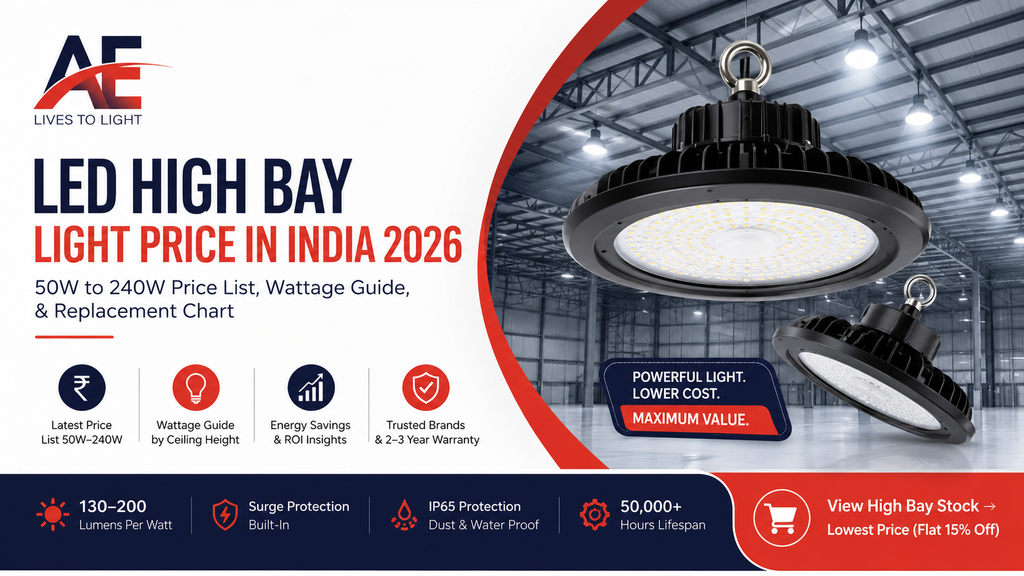
Buying an LED high bay light isn't really about the wattage printed on the box; it's about lumens, ceiling height, and how many years the fixture survives 12-hour shifts in a hot, dusty Indian shed. This guide lays out the current price bands for LED high bay lights in India across 50W to 240W, explains why two "100W" fixtures can differ in price by ₹4,000, and shows you exactly what wattage replaces your old metal halide. Want to skip straight to stock? View our LED high bay range, Flat 15% off auto-applied →
Quick price snapshot (India, May 2026): Branded LED high bay lights start around ₹1,500 for 50W, sit in the ₹2,800–₹6,500 band for 100W, ₹4,000–₹9,000 for 150W, and ₹5,500–₹12,000+ for 200W UFO fixtures. Prices swing with lumen efficacy, driver quality, IP rating, and brand warranty. Bulk orders of 25+ pieces usually land 15–25% cheaper.
Key Takeaways
- Modern LED high bays run 130–200 lumens per watt, so a 150W LED now matches a 400W metal halide that draws ~455W with its ballast (Hyperlite, 2026; Haichang Optotech, 2026).
- Buy by lumens, not watts; a 200W UFO at 190 lm/W puts out roughly 38,000 lumens, enough for a 10-meter warehouse ceiling.
- In a Delhi warehouse at ₹10+ per unit, a single 150W LED replacing a 400W metal halide can save over ₹13,000 a year, paying for itself in under a year.
LED High Bay Light Price List in India 2026 (50W to 240W)
As of May 2026, branded LED high bay prices in India sit roughly where the table below shows. These are dealer-level rates for single, AC-powered UFO and linear fixtures from tier-1 makers, the kind you'd actually install in a working factory, not the no-name imports that die in their first summer. Bulk and project quantities come noticeably cheaper, which is where most of our warehouse buyers land.
| Wattage | Approx. Lumens | Price Range (INR) | Best For |
|---|---|---|---|
| 50W | 6,500–8,000 lm | ₹1,500 – ₹3,500 | Low-bay sheds, 4–6 m ceilings |
| 70W | 9,000–11,000 lm | ₹2,000 – ₹4,500 | Small workshops, garages |
| 100W | 13,000–16,000 lm | ₹2,800 – ₹6,500 | Warehouses with 6–8 m ceilings |
| 120W | 15,500–19,000 lm | ₹3,200 – ₹7,500 | Production floors, godowns |
| 150W | 19,500–24,000 lm | ₹4,000 – ₹9,000 | 8–10 m ceilings, large sheds |
| 200W | 26,000–34,000 lm | ₹5,500 – ₹12,000 | 10–12 m ceilings, cold storage |
| 240W | 31,000–40,000 lm | ₹7,500 – ₹15,000+ | High-mast bays, heavy industry |
Ranges reflect dealer rates for branded LED high bay fittings with quality drivers. GST extra. Modular fixtures with adjustable wattage and DLC-grade optics sit at the upper end of each band.
View High Bay Stock → Lowest Price (Flat 15% Off)
Why do LED high bay prices vary so much in India?
Put two 100W high bays side by side, one at ₹2,800 and one at ₹6,500, and both will switch on and look bright in the showroom. The gap shows up after 8,000 hours, the first voltage spike, or the first monsoon dust storm pulled through the roof vents. In 2026, modern LED high bays span 130 to 200 lumens per watt depending on the LED chip generation and thermal design, according to Hyperlite's High Bay Wattage vs Lumens analysis (Hyperlite, 2026). That efficacy spread is the single biggest reason for the price gap. Here's what you're really paying for.
1. Lumen efficacy (lm/W), the number that matters
A cheap 100W fixture might deliver 11,000 lumens (110 lm/W); a premium one pushes 16,000 lumens (160 lm/W) from the same 100 watts. You're not paying for more power; you're paying for more light per rupee of electricity, every single hour, for a decade. Always check the lumen figure on the spec sheet, not just the wattage.
2. Driver quality and surge protection
The driver is the part that fails first. Fixtures with isolated, high-power-factor drivers (PF > 0.95) and built-in surge protection survive the voltage swings that fry budget units within months. In most Indian industrial belts, this isn't optional; it's the difference between a 7-year fixture and a 7-month one.
3. Housing and heat dissipation
LEDs hate heat. Die-cast aluminum bodies with proper fins pull heat away and hold output for 50,000+ hours; thin or sealed housings cook the chips early. For a shed that hits 45°C in May, the heat sink is not a detail; it's the whole game.
4. UFO vs modular build
Round UFO fixtures are compact, sealed, and cheaper to make. Modular high bays let you add or drop LED modules to tune wattage (30W up to 400W) and swap a dead module without pulling the whole fixture down, which is handy for a 12-meter ceiling where every replacement means renting a scissor lift.
5. Brand and warranty
Branded fittings from makers like Havells, Wipro, and Crompton cost 30–50% more than unbranded equivalents, but they ship with 2–3-year replacement warranties and a service network that actually answers the phone. For a factory where a dark aisle stops work, that warranty pays for itself the first time a unit fails.
100W vs 150W vs 200W high bay: which one for which ceiling?
High bay wattage is decided by ceiling height and the lux you need on the floor, not by floor area alone. The higher the fixture, the more lumens it takes to land enough light on the working plane. For a 10-meter warehouse ceiling targeting around 300 lux, each fixture should deliver roughly 28,000–38,000 lumens, which a 200W UFO at 190 lm/W (about 38,000 lumens) hits comfortably (Haichang Optotech, LED High Bay Light Complete Guide 2025, 2026). Here's the practical mapping most plant engineers in India use:
- 4–6 m ceilings (workshops, garages): 50W–70W. Anything bigger just creates glare.
- 6–8 m ceilings (general warehouses): 100W–120W. The most common pick for godowns.
- 8–10 m ceilings (large sheds, assembly): 150W. The workhorse wattage.
- 10–12 m ceilings (cold storage, heavy industry): 200W–240W, or modular fixtures.
One more variable people forget: spacing. High bays are usually spaced about 1× to 1.5× the mounting height apart. Pack them too far and you get dark aisles between pools of light; too close and you've overspent on fixtures. Get the layout done before you finalize the order; a quick lighting plan saves more money than haggling over per-unit price.
What LED wattage replaces my old metal halide high bay?
This is the question we get most from factory buyers, and the honest answer is "Match the light output, not the wattage." Metal halide lamps convert only about 20–30% of their energy into light, while LEDs convert 80–90% (Hylele, LED High Bay vs Traditional Metal Halide, 2025). So you swap a big number for a small one. As a working rule, a 250W metal halide drops to an 80–100W LED, a 400W metal halide to a 120–150W LED, and a 1000W metal halide to a 300–400W LED, cutting power draw by 60–70% (Logos Lighting, 2025).
There's a second reason the swap pays off so fast: metal halide fades. These lamps can lose up to 20% of their brightness in the first six months and around 50% by 10,000 hours, yet they keep drawing full wattage the whole time (Oteshen, 2025). An LED high bay holds its rated output (L70) to about 50,000 hours, so you're not just saving energy on day one; you're keeping the floor bright in year four.
How much can a warehouse actually save with LED high bay?
Here's where the real money sits, and most buyers undercount it. Take a Delhi warehouse running 20 fixtures, 12 hours a day, around 360 days a year. Delhi's commercial and industrial electricity averages over ₹10 per unit, among the highest in India (Smart Roof Solar, 2026), so every watt saved adds up quickly.
Our worked example: A 400W metal halide draws about 455W with its ballast. Swapping 20 of them for 20× 150W LED high bays cuts the annual load from roughly 39,300 units to about 12,960 units, saving over 26,000 units a year. At ₹10 per unit, that's more than ₹2.6 lakh saved every year, before you count zero relamping and far less maintenance.
Per fixture, that's around ₹13,000 a year in electricity alone. So a 150W LED high bay priced at ₹4,000–₹9,000 pays for itself in well under a year on a single shift and keeps paying for the next several years of its life. For a 50-fixture plant, the math gets impossible to ignore, which is exactly why most Indian factories have already made the switch.
Lighting a warehouse, factory, or cold storage?
Send us your ceiling height, shed size, and fixture count. We'll put together a project quote with the right wattage mix, IP rating, and a GST invoice, delivered across Delhi NCR and pan-India.
Get a Bulk Industrial Quote →UFO vs modular high bay: a quick buyer's call
For most warehouses up to 200W, a UFO high bay is the simpler, cheaper, sealed-and-done choice. Go modular when you're above 10 meters, need to fine-tune wattage across different zones of the same shed, or want to replace one failed module instead of an entire fixture on a tall ceiling. Modular costs more upfront but lowers the lifetime maintenance bill on hard-to-reach mounts. If you're unsure, tell us the ceiling height and we'll point you to the format that costs less over five years, not just on day one.
What we currently stock at Aarushi Electricals
We carry branded LED high bay and industrial fittings chosen for real Indian operating conditions, wide voltage tolerance, quality drivers, and proper heat sinks. Here's a snapshot of in-stock high bay and warehouse-grade fixtures with live pricing. For 100W and above in project quantities, use the bulk inquiry form so we can quote factory-fresh stock at the best per-unit rate.
| Product | Wattage | Price (incl. offer) | Buy |
|---|---|---|---|
| Havells Endura Well Glass Neo High Bay | 26W | ₹1,665 (MRP ₹3,200) | Buy Now → |
| Havells Endura Highbrite Plus High Bay | 50W | ₹1,804 (MRP ₹9,500) | Buy Now → |
| Havells Magnum Grand Neo Industrial Tube | 32W | ₹1,198 (MRP ₹6,000) | Buy Now → |
Every fitting ships with the original manufacturer warranty card and a proper GST invoice. We deliver across Delhi NCR and pan-India, and you're welcome to inspect stock or pick up directly from our shop at Bhikaji Cama Place, New Delhi. Planning a bigger project? Download our latest price list or browse the full LED high bay collection.
Choosing an LED high bay in 2026 comes down to three honest questions: how high is the ceiling, how many lumens land on the floor, and who'll replace the fixture if it fails in year two. Match wattage to ceiling height, buy by lumens rather than watts, and spend a little more on the driver and heat sink, and the fixture will outlive its warranty by years. For anything above 100W or in project quantities, talk to a dealer who'll share the spec sheet and quote you straight; that's where the real savings live.
Shop LED High Bay Lights → Flat 15% Off Auto-Applied
Frequently Asked Questions
What is the price of a 100W LED high bay light in India in 2026?
A 100W LED high bay light in India costs between ₹2,800 and ₹6,500 for branded fixtures as of May 2026, delivering roughly 13,000–16,000 lumens. Premium units with high-efficacy optics (150+ lm/W) and surge-protected drivers sit at the top of that band. Bulk orders of 25+ pieces typically reduce the per-unit price by 15–25%.
How much does a 150W and 200W LED high bay cost?
A 150W LED high bay runs ₹4,000–₹9,000, and a 200W UFO model ₹5,500–₹12,000+ in India in 2026. A 200W fixture at 190 lm/W delivers around 38,000 lumens, enough for a 10-meter warehouse ceiling. Pricing depends on driver quality, IP rating, and whether the build is UFO or modular.
What LED high bay wattage replaces a 400W metal halide?
A 120–150W LED high bay replaces a 400W metal halide while cutting power draw by 60–70% (Logos Lighting, 2025). Because LEDs convert 80–90% of energy into light versus 20–30% for metal halide, the lower-wattage LED delivers equal or better usable brightness and holds output far longer.
How fast does an LED high bay pay for itself?
On a single shift in Delhi, where commercial power averages over ₹10 per unit (Smart Roof Solar, 2026), a 150W LED replacing a 400W metal halide saves over ₹13,000 a year per fixture. At a price of ₹4,000–₹9,000, that's a payback of under a year, followed by years of pure savings plus zero relamping.
Do you provide a GST invoice and delivery across Delhi NCR?
Yes. Every LED high bay order from Aarushi Electricals ships with a proper GST invoice and the original manufacturer warranty card. We deliver across Delhi NCR and pan-India, and bulk buyers can collect directly from our shop at Bhikaji Cama Place, New Delhi, or request a project quote via the Bulk Enquiry form.
A UFO or a modular high bay, which should I buy?
Choose a UFO high bay for most warehouses up to 200W; it's compact, sealed, and cheaper. Choose modular for ceilings above 10 meters or when you want adjustable wattage and module-level replacement. Modular costs more upfront but lowers maintenance on tall, hard-to-reach mounts over a five-year horizon.
Latest Posts